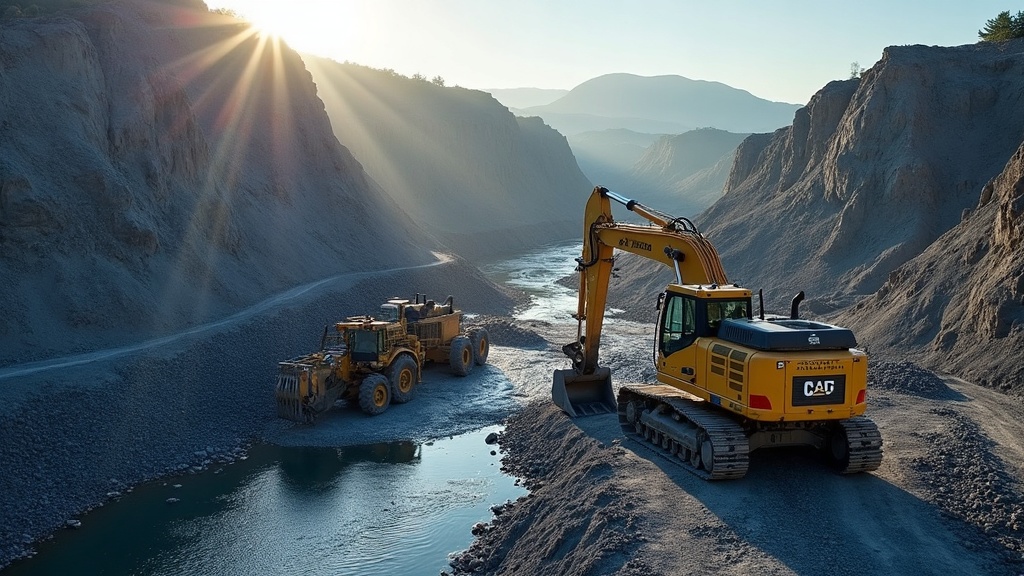
Backfill grouting in mining solutions is a critical geotechnical process that uses engineered slurries to stabilize underground voids, support surrounding rock mass, and reduce surface subsidence in both active and abandoned mines.
Table of Contents
- Quick Summary
- Backfill Grouting in Context
- Introduction
- Core Methods of Backfill Placement
- Material Science: Binders, Tailings, and Industrial By-Products
- Mechanical Performance and Curing Behavior
- Environmental and Subsidence Control Benefits
- Important Questions About Backfill Grouting in Mining
- Comparison of Backfill Methods
- Practical Tips for Backfill Grouting Operations
- Key Takeaways
- Useful Resources
Quick Summary
Backfill grouting in mining solutions is the process of injecting cementitious or non-cementitious slurries into underground voids to provide ground support, prevent subsidence, and manage mining waste. This article covers placement methods, material science, performance metrics, and environmental benefits, drawing on research from the U.S. Bureau of Mines and recent academic studies.
Backfill Grouting in Context
- Hydraulic flushing and grouting are the 2 dominant backfill methods for abandoned underground coal mines in the United States (U.S. Bureau of Mines, 1994)[1].
- Grouting reinforcement can reduce maximum surface subsidence by 30–50 percent compared to non-grouted methods (Applied Sciences, 2024)[2].
- Mine backfill technology allows re-use of 60–80 percent of fine tailings and waste rock, significantly reducing surface storage (Montanuniversität Leoben, 2014)[3].
Backfill grouting in mining solutions addresses one of the industry’s oldest challenges: what to do with the empty space left after ore extraction. When a mineral deposit is removed, the surrounding rock loses its natural support, creating risks of collapse, subsidence, and groundwater contamination. Engineers have developed a range of grouting techniques to fill these voids with engineered materials that restore structural integrity. The approach is not new – hydraulic flushing has been used for decades – but modern formulations incorporating industrial by-products and advanced binder systems have dramatically improved both performance and cost-effectiveness. This article examines the primary placement methods, the materials that make them work, the mechanical properties that define success, and the environmental advantages that make backfill grouting a cornerstone of responsible mining practice.
Core Methods of Backfill Placement
The two most widely used techniques for placing backfill material in underground mine voids are hydraulic flushing and pumped grouting. According to the U.S. Bureau of Mines, these methods are the dominant approaches for abandoned underground coal mines in the United States (1994)[1]. Hydraulic flushing relies on gravity and water pressure to transport a slurry of aggregate, binder, and water through boreholes and pipelines into the target void. It is particularly effective for large-area backfilling because it can move high volumes of material with relatively simple equipment. Pumped grouting, by contrast, uses positive-displacement pumps to inject a thicker, more controlled mix into smaller or more irregular voids. This method is preferred when precise placement is required, such as in the reinforcement of coal pillars or the sealing of fractured overburden. Both methods can be deployed from single or multiple boreholes, giving operators flexibility depending on site geometry and access constraints. Researcher Benoît Mallard of Université de Lorraine notes that backfill grouts prepared with fine tailings and binders such as cement, slag, or fly ash allow underground mines to safely fill voids while valorizing large quantities of mining waste (Cement and Concrete Composites, 2023)[4]. This dual benefit – structural support and waste management – makes the choice of placement method a critical decision in any mining operation.
Material Science: Binders, Tailings, and Industrial By-Products
The effectiveness of any backfill grouting operation depends heavily on the materials used. Traditional backfill grouts consist of a binder – typically Portland cement – mixed with water and an aggregate such as sand, crushed rock, or mill tailings. However, the modern approach increasingly incorporates industrial by-products to reduce cost and environmental impact. The U.S. Bureau of Mines identified three major categories of candidate backfill component materials: pulverized coal combustion fly ash (PCFA), flue gas desulfurization (FGD) by-products, and fluidized-bed combustion (FBC) residues (1992)[5]. These materials can be engineered to meet specific strength, permeability, and durability requirements while diverting waste from surface disposal. In cemented paste backfill systems for hard-rock mines, typical binder contents range from 3 to 7 percent by weight of dry solids, optimizing cost while delivering adequate mechanical performance (Montanuniversität Leoben, 2014)[3]. The water-to-solids ratio is another critical variable: for hydraulic-flush grouts used in abandoned coal mine voids, typical ratios range from 0.5 to 1.0 by weight, balancing pumpability and strength development (U.S. Bureau of Mines, 1994)[1]. Selecting the right combination of binder, aggregate, and water content is a site-specific engineering challenge that directly affects both the short-term flow characteristics and the long-term stability of the backfill.
Mechanical Performance and Curing Behavior
Once placed, backfill grout must develop sufficient strength to support the surrounding rock mass and resist deformation over time. Cemented backfill grouts designed for underground mine support commonly achieve unconfined compressive strengths in the range of 1 to 3 MPa at 28 days, which is sufficient for many mine stabilization applications (Cement and Concrete Composites, 2023)[4]. The rate of strength gain is also important: 50 to 70 percent of the 28-day compressive strength is often achieved within the first 7 days of curing (Cement and Concrete Composites, 2023)[4]. This rapid early strength development allows mining operations to resume activities sooner and provides immediate ground support in critical areas. Permeability is another key performance metric. Grouted backfill mixes using industrial by-products such as PCFA and FGD residues can achieve permeability coefficients on the order of 10⁻⁶ to 10⁻⁷ cm/s, effectively limiting groundwater flow through stabilized voids (U.S. Bureau of Mines, 1992)[5]. This is particularly important in abandoned mines where groundwater infiltration can lead to acid mine drainage or contamination of aquifers. Professor Zhenhua Wang of China University of Mining and Technology has shown that backfill grout reinforcement of overburden and coal pillars is an effective measure to control mining-induced subsidence in densely populated mining areas (Applied Sciences, 2024)[2]. The combination of adequate compressive strength, rapid curing, and low permeability makes properly designed backfill grouts a reliable solution for long-term mine stability.
Environmental and Subsidence Control Benefits
Beyond mechanical support, backfill grouting in mining solutions offers substantial environmental advantages. The ability to re-use up to 60 to 80 percent of fine tailings and waste rock in engineered backfill mixtures significantly reduces the need for surface tailings storage facilities, which are a major source of environmental risk in the mining industry (Montanuniversität Leoben, 2014)[3]. This practice not only conserves land but also reduces the potential for catastrophic tailings dam failures. Furthermore, the use of industrial by-products such as fly ash and FGD residues as binder components diverts large volumes of material from landfills and reduces the carbon footprint associated with cement production. The subsidence control benefits are equally compelling. Data from Applied Sciences (2024) shows that grouting reinforcement can reduce maximum surface subsidence by 30 to 50 percent compared with traditional non-grouted mining methods[2]. This is especially critical in regions where mining occurs beneath infrastructure, residential areas, or sensitive ecosystems. The U.S. Bureau of Mines noted that hydraulic flushing remains the only cost-effective method for backfilling a large area of unstable underground mine void (1994)[1], underscoring the practical importance of these techniques in both active and abandoned mine settings. For operations seeking to understand the specific rheological properties of their grout mixtures, a detailed guide on colloidal solutions for mining backfill provides valuable technical insights into mix design and quality control.
Important Questions About Backfill Grouting in Mining
What is the difference between hydraulic flushing and pumped grouting in backfill operations?
Hydraulic flushing uses gravity and water pressure to transport a slurry through boreholes and pipelines into the target void. It is best suited for large-area backfilling where high volumes of material need to be moved quickly. Pumped grouting uses positive-displacement pumps to inject a thicker, more controlled mix into smaller or irregular voids. Pumped grouting is preferred when precise placement is required, such as for coal pillar reinforcement or sealing fractured overburden. Both methods can be deployed from single or multiple boreholes, depending on site geometry.
What materials are commonly used in backfill grout mixtures?
Traditional backfill grouts consist of a binder (usually Portland cement), water, and an aggregate such as sand, crushed rock, or mill tailings. Modern formulations increasingly incorporate industrial by-products including pulverized coal combustion fly ash, flue gas desulfurization by-products, and fluidized-bed combustion residues. In cemented paste backfill systems, typical binder contents range from 3 to 7 percent by weight of dry solids. The water-to-solids ratio for hydraulic-flush grouts typically ranges from 0.5 to 1.0 by weight, balancing pumpability with strength development.
How strong does backfill grout need to be for mine support?
Cemented backfill grouts for underground mine support commonly achieve unconfined compressive strengths of 1 to 3 MPa at 28 days, which is sufficient for many stabilization applications. Strength gain is most rapid during the first 7 days, with 50 to 70 percent of the 28-day strength often achieved within that initial curing period. Permeability is also critical: grouts using industrial by-products can achieve coefficients of 10⁻⁶ to 10⁻⁷ cm/s, effectively limiting groundwater flow through stabilized voids.
What are the main environmental benefits of backfill grouting?
Backfill grouting allows mines to re-use 60 to 80 percent of fine tailings and waste rock in engineered mixtures, reducing the need for surface tailings storage facilities and lowering the risk of dam failures. Incorporating industrial by-products like fly ash diverts material from landfills and reduces the carbon footprint of cement production. Grouting also controls subsidence, with data showing a 30 to 50 percent reduction in maximum surface subsidence compared to non-grouted methods, protecting infrastructure and ecosystems above mining areas.
Comparison of Backfill Methods
Choosing the right backfill method depends on site conditions, void geometry, material availability, and cost constraints. The table below compares the three primary approaches used in modern mining operations.
| Method | Primary Mechanism | Best Application | Typical Binder Content |
|---|---|---|---|
| Hydraulic Flushing | Gravity-fed slurry transport | Large-area void filling in abandoned mines | 3–7% by weight of dry solids |
| Pumped Grouting | Positive-displacement injection | Precise placement in irregular voids or pillar reinforcement | 3–7% by weight of dry solids |
| Paste Backfill | Thick, non-segregating slurry pumped underground | Active hard-rock mines requiring high-strength support | 3–7% by weight of dry solids |
Practical Tips for Backfill Grouting Operations
Effective backfill grouting requires careful planning and quality control. First, always conduct a thorough site investigation to characterize void geometry, groundwater conditions, and rock mass quality before selecting a placement method. Second, perform laboratory mix design tests using site-specific aggregates and binders to determine the optimal water-to-solids ratio and binder content. Third, monitor the grout’s rheological properties – viscosity, yield stress, and setting time – during placement to ensure consistent quality. Fourth, install instrumentation such as pressure cells and extensometers to verify that the backfill is performing as designed over time. Fifth, consider using a backfill slurry with a controlled particle size distribution to improve pumpability and reduce segregation. Finally, when working in abandoned mines, prioritize hydraulic flushing for large-area voids and reserve pumped grouting for targeted reinforcement of pillars or fractured zones. These practices will help maximize both safety and cost-effectiveness.
Key Takeaways
Backfill grouting in mining solutions is a mature yet evolving technology that plays a vital role in underground mine safety, waste management, and environmental protection. From hydraulic flushing in abandoned coal mines to paste backfill in active hard-rock operations, the choice of method and material must be tailored to each site’s unique conditions. The use of industrial by-products not only reduces costs but also addresses pressing environmental concerns. As the mining industry continues to emphasize sustainability and safety, backfill grouting will remain an essential tool. For a deeper understanding of how backfill gravel and other aggregates influence grout performance, explore our related resources.
Useful Resources
- State-of-the-Art Techniques for Backfilling Abandoned Underground Coal Mines. U.S. Bureau of Mines (via National Institute for Occupational Safety and Health repository).
https://stacks.cdc.gov/view/cdc/206318/cdc_206318_DS1.pdf - Grouting Reinforcement Technology for Underground Coal Mines. Applied Sciences (MDPI).
https://www.mdpi.com/2076-3417/14/6/2599 - State of the Art of Backfill Technology in Underground Mining. Montanuniversität Leoben.
https://pure.unileoben.ac.at/ws/portalfiles/portal/2402127/AC12252913n01vt.pdf - Performance of grouted backfill using fine tailings for underground mine support. Cement and Concrete Composites (Elsevier).
https://hal.science/hal-04332456/document - Candidate Backfill Materials for Abandoned Underground Coal Mines. U.S. Bureau of Mines (via National Institute for Occupational Safety and Health repository).
https://stacks.cdc.gov/view/cdc/235651/cdc_235651_DS1.pdf