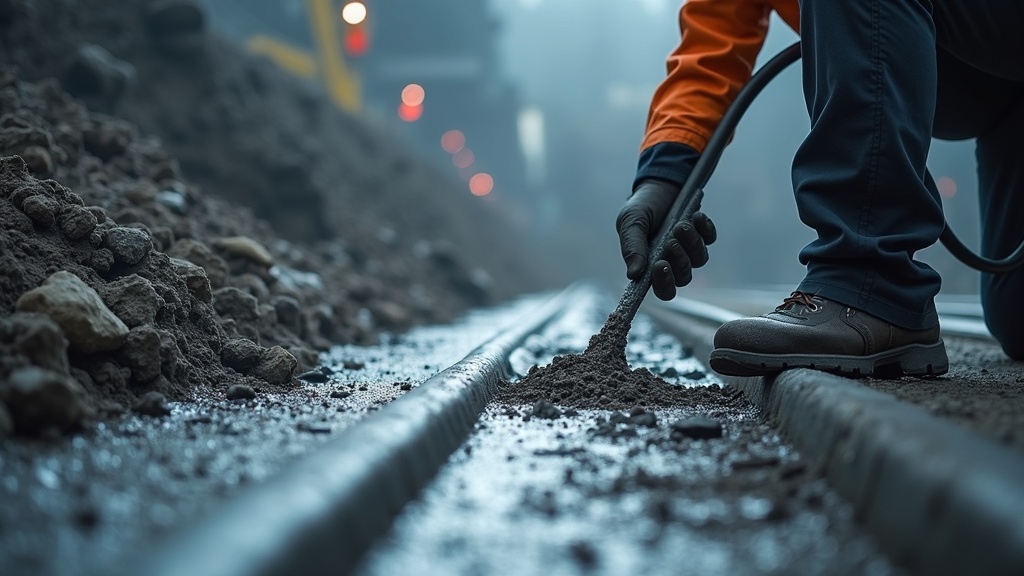
Grout in mining solutions is critical for ground control, water management, and structural reinforcement in underground operations. This guide examines modern grouting materials, application techniques, and performance data that help mining and tunneling engineers achieve safer, more efficient excavations.
Table of Contents
- The Role of Grout in Mining and Tunneling
- Rapid-Strength Grout Formulations for Cable Bolting
- Advanced Grouting in Fault Fractured Zones
- Composite Grout Materials for Fractured Rock Reinforcement
- Frequently Asked Questions
- Grout Material Comparison
- Practical Tips for Grouting Operations
- Final Thoughts on Grout in Mining Solutions
Grout in mining solutions is a specialized technique for stabilizing underground excavations by injecting cementitious or chemical materials into rock fractures and voids. This article covers rapid-strength cable bolt grouts, advanced grouting in fault zones, composite bentonite-cement materials, and practical field tips for tunneling applications.
Grout in Mining Solutions: Key Statistics
- Alternative grout materials such as LH cement with admixtures achieved minimum curing times of just 2 hours to reach tensioning strength (Australian Centre for Geomechanics, 2023)[1]
- Positioning the final advanced grouting hole within 1.0 meter above the coal–rock interface significantly reduces grout leakage risk in deep mining faces (Frontiers in Earth Science, 2025)[2]
- Composite bentonite-cement grout with an optimum bentonite–cement ratio of 1.0 by mass achieved compressive strengths exceeding 10 MPa after 28 days (Chinese Academy of Sciences, 2018)[3]
- Effective pre-grouting can reduce underground groundwater inflow by up to ten-fold compared with ungrouted conditions (Colloidal Grout Mixer industry overview, 2026)[4]
The Role of Grout in Mining and Tunneling
Grout in mining solutions serves as a primary method for improving ground stability and controlling water inflow during underground excavation. The process involves injecting a fluid mixture – typically cement-based, chemical, or composite – into fractures, voids, or soil pores to increase the strength and reduce the permeability of the rock mass. In tunneling, grouting is used ahead of the excavation face to pre-treat poor ground conditions, preventing collapses and limiting water ingress that can halt operations.
Modern mining operations require grouts that not only provide structural support but also set quickly to minimize downtime. As Andrew Jere, a mining engineer at the Australian Centre for Geomechanics, noted in his 2023 research, alternative grout materials can achieve curing times as low as two hours for cable bolt tensioning[1]. This speed is critical in underground development cycles where every hour of delay impacts productivity. The choice of grout depends on several factors, including rock type, groundwater chemistry, required strength, and the specific application – whether for rock bolting, void filling, or water cutoff. Understanding these variables is essential for selecting the appropriate grouting system and achieving the desired engineering outcomes.
Rapid-Strength Grout Formulations for Cable Bolting
Rapid-strength grouts have transformed cable bolting in underground mining by drastically reducing waiting times between installation and tensioning. Traditional Ordinary Portland Cement (OPC) grouts often require 24 hours or more to develop sufficient strength, but newer formulations cut that to a fraction of the time. According to a 2023 study published by the Australian Centre for Geomechanics, LH cement with admixtures achieved minimum curing times of two hours to reach the strength required for tensioning cable bolts[1]. Prebagged HYS cement reached tensioning strength in approximately six hours, and HES cement systems required about eight hours[1].
These accelerated curing times come from optimized particle size distributions and chemical admixtures that control hydration rates. The research demonstrated that these alternative grout materials offer significant improvements in strength development compared to OPC. For mining engineers planning underground development cycles, adopting rapid-strength grouts can reduce cycle times by hours per round, directly improving production rates. When specifying a grout for cable bolting, it is important to verify that the chosen formulation meets the specific strength requirements of the ground support design while also being compatible with the available mixing and pumping equipment. For operations seeking a reliable mixing solution, the comprehensive grout mixing guide provides detailed specifications for achieving consistent batch quality.
Advanced Grouting in Fault Fractured Zones
Grouting in fault fractured zones presents unique challenges because these areas are often highly permeable and structurally weak. In deep, large-mining-height fully mechanized mining faces, fault zones can cause catastrophic water inrushes and roof collapses if not properly treated. Research published in Frontiers in Earth Science in 2025 by Shuai Zhang and colleagues examined the mechanism of advanced grouting reinforcement in such conditions[2]. The study found that vertical positioning of the final grouting hole within 1.0 meter above the coal–rock interface achieves balanced collaborative reinforcement of the coal and roof, improves effective grouting efficiency, and reduces grout leakage into the fault zone.
This precision in hole placement is critical because it ensures that the grout penetrates the fractured zone without escaping into unproductive areas. The study also highlighted that the grout must be designed to withstand the dynamic stresses of mining. James Goodman, a principal engineer at Golder Associates, emphasized in a 2018 conference paper that grout needs to act as a healing solid that maintains adhesion to wet rock surfaces despite continued blasting, mining-induced subsidence, and high groundwater pressures[5]. For tunneling projects that intersect fault zones, combining accurate hole placement with a grout formulation that remains flexible after setting is essential for long-term stability. Engineers should also consider using solution grouts – very low-viscosity, two-component systems – when cementitious grouts cannot penetrate the fine fractures typical of fault gouge material.
Composite Grout Materials for Fractured Rock Reinforcement
Composite grout materials, particularly bentonite–cement systems, offer a balance of mechanical performance and cost-effectiveness for reinforcing fractured rock in mining applications. A 2018 study from the Chinese Academy of Sciences, published in Advances in Materials Science and Engineering, optimized a composite grout formulation specifically for underground mining reinforcement[3]. The optimum bentonite–cement ratio was determined to be 1.0 by mass, with a water–solid ratio of 3.5. The accelerator content was optimized at 2.9 percent of the total solid mass, and the retarder content at 1.45 percent.
These proportions produced a grout that achieved compressive strengths exceeding 10 MPa after 28 days of curing, providing adequate bearing capacity for fractured rock masses[3]. The bentonite component improves the grout’s pumpability and reduces bleeding, while the cement provides the structural strength. As Liang Chen, the lead author of the study, noted, by balancing compressive and flexural properties while improving environmental performance, composite grouting materials provide a more durable and economical solution for reinforcing fractured rock[3]. For mining operations dealing with variable ground conditions, composite grouts can be tailored on-site by adjusting the water–solid ratio or admixture dosages. This flexibility makes them suitable for a wide range of applications, from void filling to systematic rock mass improvement ahead of the tunnel face.
Important Questions About Grout in Mining Solutions
What is the difference between cementitious grout and chemical grout in mining?
Cementitious grout is a mixture of cement, water, and sometimes additives like bentonite or sand. It is cost-effective, provides high strength, and is suitable for larger fractures and voids. Chemical grout includes polyurethane, acrylate, or sodium silicate systems that have very low viscosity and can penetrate fine cracks and soil pores. As David Farrell, a senior grouting specialist, explained in a 2024 webinar, when cementitious grouts are unable to penetrate the geology, solution grouts are warranted because they are designed to permeate soils or matrix formations to control groundwater or stabilize ground[6]. The choice depends on the fracture aperture, groundwater flow rate, and required strength.
How does grout in mining solutions improve ground stability?
Grout improves ground stability by filling fractures and voids, which increases the overall strength of the rock mass and reduces its permeability. When injected under pressure, the grout bonds to the rock surfaces, creating a composite material that can resist deformation and prevent block movement. In cable bolting, the grout transfers load from the bolt to the surrounding rock. In pre-grouting ahead of a tunnel face, the grout creates a watertight umbrella that prevents water inflow and stabilizes loose ground. The effectiveness of this treatment is demonstrated by industry data showing that effective grouting can reduce groundwater inflow by up to ten-fold compared with ungrouted conditions[4].
What are the key factors in selecting a grout mix for underground mining?
Key factors include the required unconfined compressive strength, setting time, viscosity, and cost. The rock mass characteristics – fracture size, groundwater chemistry, and flow rate – also dictate the grout type. For rapid cable bolting, fast-setting grouts like LH cement with admixtures that cure in two hours are preferred[1]. For fine fractures in fault zones, low-viscosity chemical grouts or composite bentonite-cement grouts with optimized water–solid ratios (such as 3.5) are used[3]. The mixing equipment must also be compatible; for example, high-shear colloidal mixers are required for bentonite-based grouts to achieve proper dispersion.
How long does grout take to cure before mining can resume?
Curing time varies by grout type. Rapid-strength grouts for cable bolting can achieve tensioning strength in as little as two hours for LH cement with admixtures, six hours for HYS cement, and eight hours for HES cement[1]. Standard OPC grouts may require 24 hours or more. For composite bentonite-cement grouts used in void filling or rock reinforcement, compressive strengths exceeding 10 MPa are typically reached after 28 days of curing, though the ground may be safe for light activity after 12 to 24 hours depending on the design[3]. Always verify the specific grout’s curing data through field trials before resuming full production.
Grout Material Comparison for Mining Applications
Selecting the right grout material depends on the specific ground conditions and performance requirements. The table below compares three common grout types used in underground mining and tunneling.
| Grout Type | Typical Curing Time | Compressive Strength (28 days) | Best Application |
|---|---|---|---|
| LH Cement with Admixtures | 2 hours | Variable (high early strength) | Rapid cable bolt tensioning |
| Composite Bentonite-Cement | 12–24 hours (initial set) | Exceeds 10 MPa | Fractured rock reinforcement, void filling |
| Chemical Solution Grout | Seconds to minutes | Low (primarily water control) | Fine fracture sealing, groundwater cutoff |
Practical Tips for Grouting Operations
Effective grouting in mining requires careful planning and execution. Here are actionable tips based on current research and industry best practices.
- Optimize hole placement: For advanced grouting in fault zones, position the final injection hole within 1.0 meter of the coal–rock interface to maximize reinforcement and minimize leakage[2]. Use borehole cameras or geophysical logging to confirm fracture orientation before drilling.
- Match grout to ground conditions: Use rapid-strength grouts (LH, HYS, or HES cements) for cable bolting where cycle time is critical[1]. For highly fractured or water-bearing ground, consider composite bentonite-cement grouts with a water–solid ratio of 3.5 to improve pumpability and reduce shrinkage[3].
- Control admixture dosages precisely: The optimum accelerator content for composite grouts is 2.9% and retarder content is 1.45% of total solid mass[3]. Overdosing accelerator can cause flash set, while underdosing retarder may lead to premature hardening in the mixer or pump.
- Monitor groundwater inflow reduction: Track pre- and post-grouting inflow rates to verify effectiveness. A ten-fold reduction in inflow is a realistic target for well-designed grouting programs[4]. If inflow remains high, consider switching to a solution grout for the next injection pass.
For more about Grout, see find grout resources.
Final Thoughts on Grout in Mining Solutions
Grout in mining solutions is a proven technology for enhancing safety and productivity in underground operations. From rapid-strength cable bolt grouts that cure in two hours to composite bentonite-cement systems that provide durable reinforcement for fractured rock, modern grouting materials offer engineers a versatile toolkit for ground control. The key to success lies in matching the grout formulation to the specific geological conditions and operational requirements. For tunneling and mining professionals looking to improve their grouting efficiency, explore the best AI certifications to stay current with industry advancements, or read about D.C. in Washington D.C. for broader context on infrastructure projects.
Useful Resources
- Improving underground development cycle time using rapid cable bolt grouting systems. Australian Centre for Geomechanics.
https://papers.acg.uwa.edu.au/d/2325_40_Jere/40_Jere.pdf - Study on the mechanism of advanced grouting reinforcement in fault fractured zones of deep large-mining-height fully mechanized mining faces. Frontiers in Earth Science.
https://www.frontiersin.org/journals/earth-science/articles/10.3389/feart.2025.1635731/full - Development and application of new composite grouting materials in underground engineering. Chinese Academy of Sciences / Advances in Materials Science and Engineering.
https://pmc.ncbi.nlm.nih.gov/articles/PMC5884856/ - Grout in Mining Overview. Colloidal Grout Mixer.
https://www.colloidalgroutmixer.com/2026/07/19/grout-in-mining-overview/ - Mine water control using underground grouting. IMWA 2018.
https://imwa.info/docs/imwa_2018/IMWA2018_Goodman_507.pdf - Interactive Conversation on Controlling Groundwater in Underground Mining. YouTube.
https://www.youtube.com/watch?v=ykjaIQXlGXQ